| ||||||||||||
x
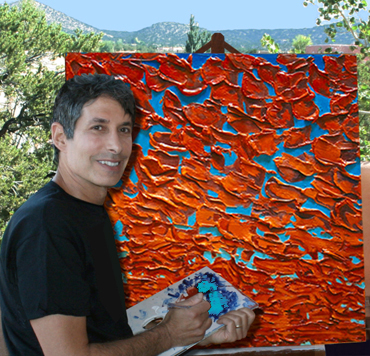 My body of work for the past 32 years has shared one consistent element: fresco-secco. After many years as a traditional oil painter, I began to experiment with painting acrylic washes on a plaster/lime surface in hopes of capturing a wall mural effect similar to those found in my studies of archeology and ancient art history. In 1990 I proceeded to create my first fresco-secco style piece with much exhilaration. Because I was educating myself in a new medium, it moved me to think beyond any previous formal training, which proved quite invaluable. My passion for creating fresco-inspired paintings grew and flourished for the next 12 years. In February 2002 I opened Bogdanoff Gallery, a working studio on Royal Street in New Orleans’ historic French Quarter. In 2006 I relocated the gallery to Santa Fe, NM, home to America’s third largest art market.
I am influenced by historic art from the Greek Bronze Age through the end of the Renaissance: scenes depicted in wall murals, friezes, reliefs, vase paintings, and sculptures. I strive to capture the essence of not only a time in civilizations lost but also of past cultures. I envision what perceptual properties and styles would be best adapted for a displayed wall painting of a specific subject at that time in history and assimilate my interpretation onto the plaster canvas. I also incorporate my neo-expressionist and realist works with the fresco-secco technique to convey an added dimension to the narrative through a blend of classic and modern styles. In the past few years I’ve introduced works featuring heavily textured surfaces. In order to achieve this, I spread plaster onto either cradled panel board or canvas using knives and fingers. During this process I consider the subject matter that I want to convey as my end result, and contour the plaster to achieve my vision. This process gives the work additional depth and character enhanced by shadows and highlights. My latest body of work, “Biosphere,” has an abstract bent. The Earth’s layers, together with rock, water and atmospheric conditions are my inspiration. From the earliest ages of our planet, these elements conger up primal and raw imagery that I apply to this collection. My objective is to illustrate the rich beauty of the planet’s life-support systems, and to bring awareness to the plight we face if action is not taken. My initial introduction to fresco art came during my studies of the Greek Minoan civilization, circa 1500BC. The artists from the settlement of Akrotiri on the island of Thera (now known as Santorini) were innovators in utilizing color from the earth, and their free style of drawing and interpretation of subject matter was extraordinary. I believe that art as we know it today was borne from these ancient artists, and I honor them through my work. |
||||||||||||


©Copyright, 1999-2025, Steve Bogdanoff / Bogdanoff Gallery / Art of Bogdanoff
All artwork copyrights are held and retained by the artist Steve Bogdanoff.
Images are not to be printed, copied, appropriated
or distributed without prior permission of the artist.
Purchase of artwork does not convey copyrights.
or distributed without prior permission of the artist. Purchase of artwork does not convey copyrights.